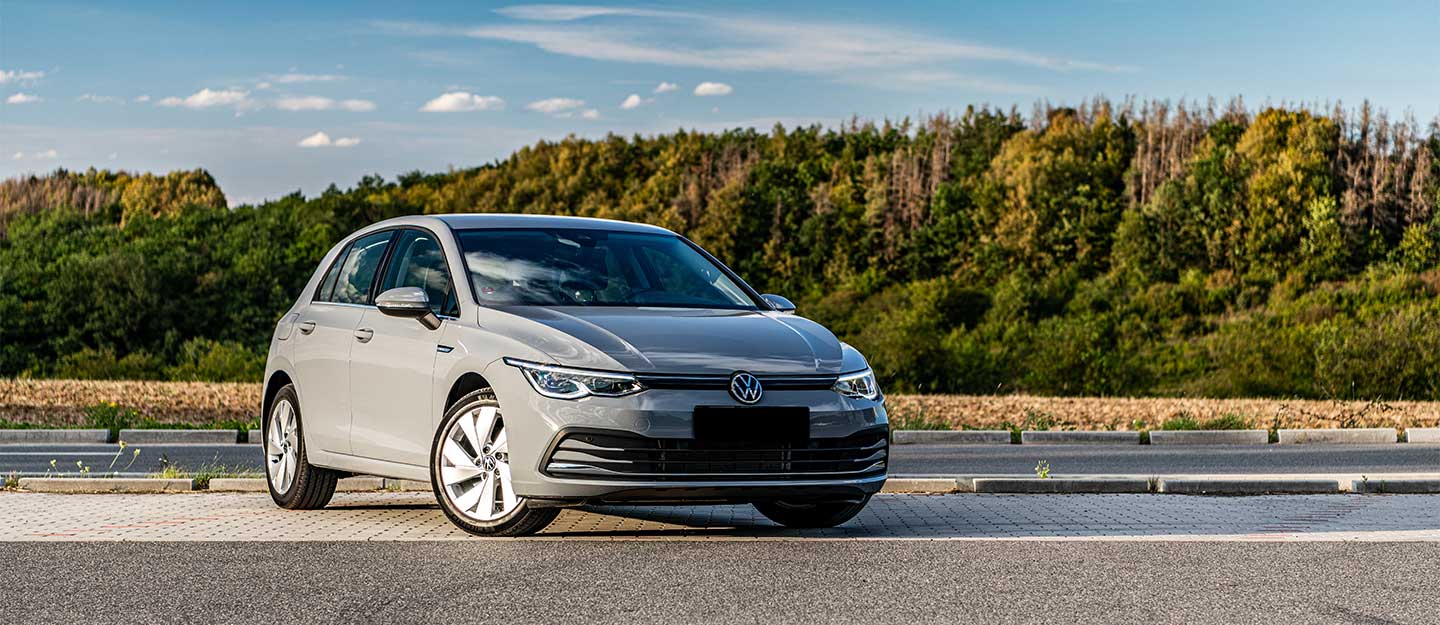
The Volkswagen Golf is a compact car produced by the German automaker Volkswagen. The car has a rich history spanning over four decades. Since its debut in 1974, the Golf has been one of the best-selling cars worldwide. Let’s take a detailed look at the VW Golf’s history, its evolution and generations.
Evolution of Volkswagen Golf

For almost four decades, the VW Golf has set benchmarks in terms of design, performance and innovation in the compact car segment. The Golf’s versatility, from a practical family car to a sporty hatchback, ensures its continued relevance and popularity in the global market. Let’s review the evolution of the Volkswagen Golf car model.
First Generation (Mk1: 1974–1983)
The first series-production Volkswagen Golf rolled off the Wolfsburg production line in March 1974 and hit dealerships by May of the same year. This marked the beginning of a new era, replacing the Beetle’s long-standing dominance with its rear-mounted engine and rear-wheel drive. The Golf, along with the Scirocco and Passat, introduced in 1973, spearheaded the shift to a front-mounted engine and front-wheel drive configuration. Besides, it’s all about engine placements in cars.
The Golf Mk1, designed by Giorgetto Giugiaro in collaboration with Volkswagen, was tasked with the monumental challenge of succeeding the legendary Beetle.
The Golf’s modern and safe driving system, combined with the flexibility of a tailgate and folding rear seat backrest, proved to be highly appealing. Its design also won over many customers.
As VW Golf history has it, important features introduced in those models included front-wheel drive, a transversely mounted front engine, and a hatchback design.
Significant models introduced in this generation include the GTI version. The model introduced in 1976 is often credited with inventing the hot hatch segment.
Those interested in the model can explore these used Volkswagen GTI cars for sale in the UAE.
Second Generation (Mk2: 1983–1992)
The Mk2 launched in the second generation was larger, more refined and more aerodynamic than its predecessor. The second-generation Golf was the car that many baby boomers, now around 50 years old, learned to drive in. While its predecessor had already become a favourite among driving instructors and learners, the new Golf solidified its place with this generation.

This iteration of the Golf brought advanced technologies to the masses, including a lambda-probe-controlled catalytic converter, anti-lock brakes (ABS) and the product line’s first all-wheel-drive system. Moreover, the Golf Syncro, an early all-wheel-drive version, debuted during this generation.
Third Generation (Mk3: 1991–1997)
In August 1991, Volkswagen introduced the third-generation Golf, ushering in a new era of safety. This model was the first in the Golf lineup to offer front airbags, starting in 1992. Significant advancements in body design also greatly improved crash safety. This revolutionised passive safety and benefited millions of drivers worldwide.
The Mk3 Golf is notable for several key milestones, including several firsts. These include six-cylinder engines, cruise control systems and diesel engine oxidising catalytic converter. It also featured the debut of a diesel direct-injection engine and side airbags.
Significant models introduced in the third generation include the VR6 model. The vehicle, with a narrow-angle V6 engine, offered significant performance improvements.
Fourth Generation (Mk4: 1997–2003)

The Mk4 Golf is widely regarded by design experts as a pioneering style icon. It was notable for its improved build quality, comfort and refinement.
The model bridged the gap between the clear features of the original 1974 Mk1 Golf and the distinctive C-pillar design of the product line. Volkswagen set a new quality standard in the segment with the Mk4 Golf, which also marked the debut of the Electronic Stability Control, further enhancing safety for the masses.
Key milestones for the Mk4 Golf include an improved 4Motion all-wheel-drive system and the 2001 launch of the Golf GTI 132 kW, celebrating the GTI’s 25th anniversary and now a sought-after classic. This generation also introduced a Golf powered by an FSI engine in 2002, along with head-protection airbags as a standard feature. It also released the sportiest Golf of the time, the R32, in 2002, with a top speed of 250 km/h.
In 2003, the Golf R32 became the first Golf available with a dual-clutch gearbox (DSG). The Golf R32, with a 3.2L VR6 engine and all-wheel drive, became a cult favourite. Here is a list of Golf R cars for sale in the UAE.
Fifth Generation (Mk5: 2003–2008)
The fifth-generation Golf set new standards for comfort and dynamics, surpassing many competitors in the mid-size car category. The car model featured a laser-welded body that increased torsional rigidity upon its 2003 debut.
For the first time, the Golf offered optional rear side airbags, adding to the six standard airbags (front, side at the front and head-protection), bringing the total to eight.
According to the VW Golf model history, the Mk5 Golf excelled in comfort and performance, thanks to features such as a new four-link rear suspension, a new 7-speed DSG transmission, and Bi-xenon headlights. It also featured rain sensors and a tilting and sliding panoramic sunroof.
The model also introduced a turbocharged direct petrol-injection engine in the Golf GTI and a Twincharger engine that combined turbocharging and supercharging. There were significant improvements in ride quality and handling, with a new fully independent rear suspension. Here is a detailed overview of the history of turbochargers.
Moreover, the introduction of TSI and TDI engines offered better performance and fuel efficiency. The Mk5 GTI was lauded for reviving the performance spirit of the original GTI.
Sixth Generation (Mk6: 2008–2012)

By the end of July 2012, Volkswagen had produced 2.85 million units of the sixth-generation Golf, which was introduced in 2008. This generation marked a significant leap in safety. It also featured a standard knee airbag, enhancing passenger protection. The Mk6 Golf set new standards in interior quality and introduced advanced assist systems, including:
- Light Assist dynamic main beam control
- Park Assist
- Hill Start Assist
- Adaptive chassis control (DCC)
These innovations helped it earn the title of ‘World Car of the Year’ in 2009. Additional features like the start/stop system, energy recovery mode, dynamic cornering lights and LED tail light clusters garnered Mk6 Golf the most advanced and progressive model in the Golf lineup.
Moreover, the introduction of BlueMotion models focused on lower emissions and better fuel economy. The sixth generation of VW cars boasted more advanced infotainment systems and driver assistance features.
Seventh Generation (Mk7: 2012–2019)

In 2012, Volkswagen unveiled the seventh-generation Golf in Berlin. Built on the MQB platform, the new Golf’s weight was reduced by up to 100 kg, addressing the commonly cited issue of increasing vehicle weight. Depending on the engine, this weight reduction resulted in up to a 23% decrease in fuel consumption compared to its predecessor. Volkswagen also equipped the Mk7 Golf with a host of new assist systems, including:
- Automatic Post-Collision Braking System
- Proactive occupant protection system
- ACC Adaptive Cruise Control
- Front Assist area monitoring system with City Emergency Braking
The generation also introduced new turbocharged engines and a plug-in hybrid version, the Golf GTE. As for high-tech features, the seventh generation launched advanced driver assistance systems, a digital cockpit and improved connectivity options.
Eighth Generation (Mk8: 2019–Present)

MK8 focused on digitalisation with a fully digital cockpit, advanced infotainment and connectivity features. The generations also emphasised hybrid and electric models, with the e-Golf and ID.3 taking centre stage. As for sustainability, the models of this generation are made using sustainable materials and production methods. Here is a list of used VW ID.3 cars for sale in the UAE for those interested in electric models.
FAQs
What significant model was introduced in the first generation of the Volkswagen Golf?
The GTI version, introduced in 1976, is often credited with inventing the hot hatch segment.
What advancements did the second-generation Volkswagen Golf bring?
The second-generation Golf introduced advanced technologies like a lambda-probe-controlled catalytic converter, anti-lock brakes (ABS) and the product line’s first all-wheel-drive system.
What safety features were introduced in the third generation of the Volkswagen Golf?
The third-generation Golf introduced front airbags and advancements in crash safety design.
What notable milestones were achieved in the fourth generation of the Volkswagen Golf?
The fourth-generation Golf marked the debut of Electronic Stability Control, the introduction of a direct petrol injection engine (FSI) and the launch of the Golf GTI 132 kW to commemorate the GTI’s 25th anniversary.
That is all about the VW Golf generations and history. Enthusiasts of the automaker can also go through the history of the VW logo to know more about the model’s importance and significance. Besides, here are some interesting facts about Volkswagen.
For more on various car model histories, stay tuned to dubizzle cars blog.
Cover Image Credits: Shutterstock Photo Contributor – tomas devera photo.
Related Posts