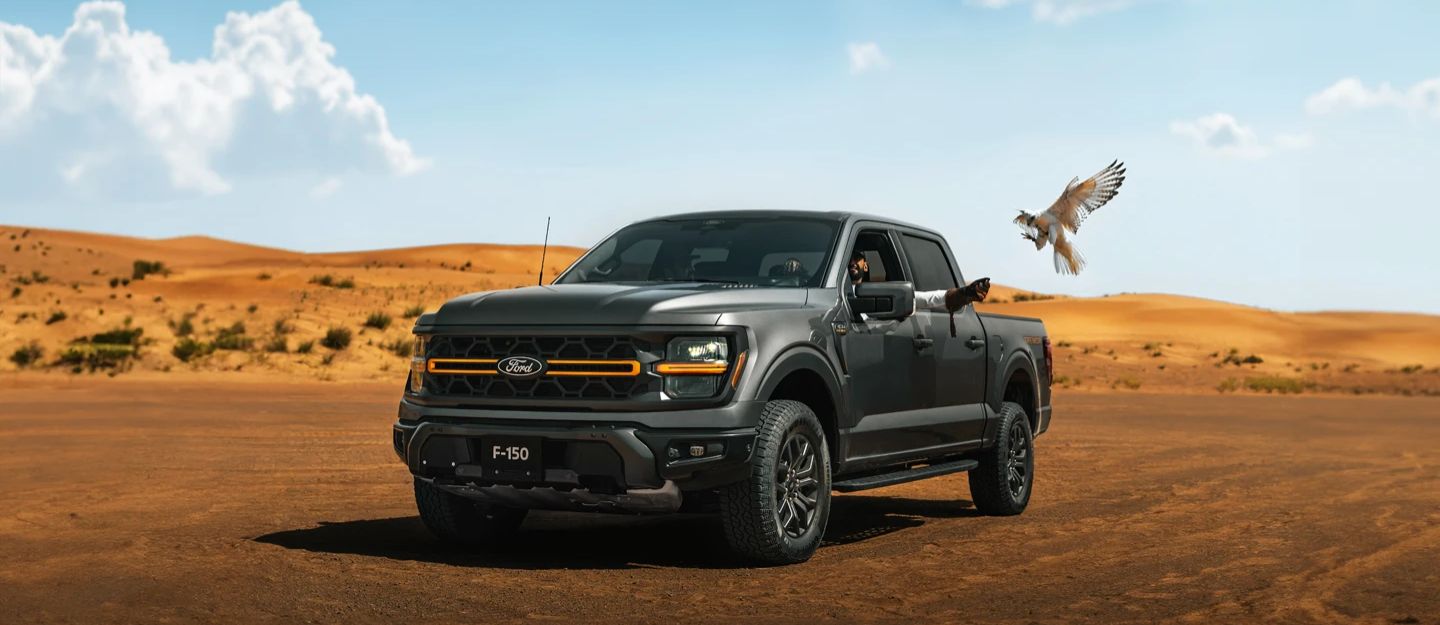
The Ford F-Series has been a symbol of reliability and innovation since its launch in 1948. Over the decades, the F-150 has cemented its place as America’s best-selling vehicle, evolving in terms of design, technology and performance advancements. Let’s take a journey through the Ford F-150 history, exploring its evolution across generations.
The Evolution of the Ford F-150: A Journey Through Generations
Here is the history of the Ford F-150, showcasing its transformation from a workhorse to a high-tech, performance-driven truck.
Sixth Generation of F-Series: The Arrival of the F-150
The Ford F-150 made its debut in 1975 as part of the sixth-generation F-Series lineup, offering a perfect balance of size and capability. Available in regular and super cab configurations, it catered to both commercial and personal use.
Under the hood, the base model featured a 4.9-litre inline six-cylinder engine generating 113 hp. For those needing more power, Ford provided two V8 engine options, producing 145 and 160 hp, respectively. In 1976, Ford introduced an additional V8 engine, providing improved performance. A notable styling update came in 1978 when Ford replaced the traditional circular headlights with rectangular ones.
Seventh Generation of F-Series: Lighter and More Efficient
The upgraded version of the Ford F-150 was introduced for the 1980 model year as part of the seventh-generation F-Series. This marked a significant shift in design and engineering. In 1980, Ford introduced a redesigned F-150 with a lighter frame while maintaining strength. The truck featured an egg-crate grille and enhanced ride quality.
The inline six-cylinder remained the base engine. Two V8 options, a 5.0-litre and 5.8-litre, offered over 130 horsepower and 230 lb-ft of torque. In 1981, Ford introduced a four-speed manual and automatic transmission for better driving flexibility.
In 1982, Ford replaced the ‘FORD’ hood lettering with the now-iconic Blue Oval badge. By 1985, electronic fuel injection was introduced for the inline-six and base V8 engines.
Eighth Generation of F-Series: A Smoother and Sportier Ride
With the launch of the eighth-generation F-Series in 1987, the F-150 saw further refinements in style and performance. A four-speed manual transmission became standard, with an optional four-speed automatic.

Ride quality improved, making the F-150 a more comfortable daily driver. In 1988, a five-speed manual transmission replaced the four-wheel-drive system, while automatic options remained available. In 1991, Ford introduced the Nite Edition, featuring a sleek, blacked-out look exclusive to XLT Lariat and Bronco models.
Ninth Generation of F-Series: Safety Takes the Spotlight
The F-150, as part of the ninth-generation F-Series, debuted in 1992 with a greater focus on safety and performance. Engine options included a base inline-six and two V8s—a 5.0-litre and a 5.8-litre. These engines were paired with various transmission choices, including three- and four-speed automatics and four- or five-speed manuals.
The Nite Edition was discontinued after 1991, making way for the high-performance SVT Lightning in 1993, powered by the 5.8-litre V8. In 1994, Ford introduced standard driver airbags and 1995 marked the end of the inline-six. That same year, the F-Series became the world’s best-selling vehicle, surpassing the Volkswagen Beetle.
Tenth Generation of F-Series: A Modern Look and Stronger Performance
Debuting at the 1996 Detroit Auto Show, the tenth-generation F-Series featured a more rounded design, focusing on passenger comfort and towing strength. It introduced a lighter F-150 chassis and a torsion-bar suspension and replaced the inline-six with a 4.2-litre V6, alongside 4.6-litre and 5.4-litre V8 options.
In 1999, the 360-hp SVT Lightning returned and Ford added rear-hinged doors to the SuperCab. The SuperCrew Cab with four full-size doors and the luxury King Ranch trim further expanded its appeal.
Eleventh Generation of F-Series: Bigger, Bolder and Safer
The 2004 F-150 received a bold, squared-off redesign. Both regular cab and SuperCrew models featured four doors, enhancing practicality. Interior comfort improved, making it more family-friendly.
The base V6 engine carried over with a five-speed manual transmission, while the 5.4-litre Triton V8 remained an automatic-only option. With a five-star safety rating and multiple awards, this generation solidified the F-150 reputation as both a workhorse and a family truck.
Twelfth Generation of F-Series: Strength Meets Innovation
In 2009, the twelfth-generation F-Series debuted the Ford F-150 with a fully boxed frame, a tougher design and luxury features. Its styling echoed the Super Duty lineup, enhancing its showroom appeal.
New engine options included the 3.5-litre twin-turbo EcoBoost V6, 3.7-litre V6, 5.0-litre V8 and 6.2-litre V8. In 2010, the off-road-ready SVT Raptor launched with a 320 hp, 5.4-litre V8 engine, later upgraded to a 411 hp 6.2-litre V8.
Luxury refinements continued, with HID headlights, heated seats and the high-end Platinum trim offering premium leather and 20-inch chrome wheels. The 2014 Tremor edition, a sportier F-150, featured unique graphics, an electronic locking rear differential and performance-focused upgrades.
Thirteenth Generation of F-Series: Aluminum and Advanced Tech
The 2015 F-150 introduced a revolutionary aluminum body, reducing weight while improving fuel efficiency. This generation offered multiple configurations, including regular, crew and super cab models. It was larger than previous models and offered a range of engines, including a base V6, 2.7-litre and 3.5-litre EcoBoost V6s, a 3.0-litre turbo diesel and a 5.0-litre V8.
Available in regular, crew and super cab configurations, it featured luxury upgrades like LED headlights, advanced safety tech and a 10-speed automatic transmission. It became the first pickup to earn a five-star NHTSA safety rating, maintaining its best-selling status.
Fourteenth Generation of F-Series: Electrification and Cutting-Edge Tech
Introduced in 2020, the latest F-150 brings hybrid and all-electric options alongside its traditional powertrains. Key updates include a hybrid PowerBoost model, a 10-speed automatic transmission across all trims and enhanced safety features like an optional hands-free driving system and Ford Co-Pilot360.
Powertrain options include a 5.0-litre V8, multiple V6 engines—including two twin-turbo Ford Ecoboost engines—a 3.0-litre turbo-diesel and a naturally aspirated 3.3-litre V6. The F-150 also introduced an onboard generator, a 12-inch touchscreen infotainment system, Ford SYNC 4 and various trim-specific upgrades.
For 2022, the lineup expanded with the off-road-ready Tremor, the all-electric F-150 Lightning and the Rattler, an affordable off-road package. The Raptor set a new standard for off-road capability with features like Fox Racing shocks, skid plates and electronic locking differentials. It also earned admiration from enthusiasts worldwide.
FAQs
When was the Ford F-150 first introduced?
The Ford F-150 debuted in 1975 as part of the sixth-generation F-Series lineup.
What is the F-150 PowerBoost?
The PowerBoost is the first hybrid F-150, introduced in 2021, combining a 3.5-litre EcoBoost V6 with an electric engine.
What does the F in F-150 stand for?
The ‘F’ in F-150 stands for ‘Ford’, while the number represents the truck’s size and capability within the F-Series lineup.
With this, we conclude the Ford F-150 history. The Ford F-150 car history stands as a testament to the brand’s commitment to pushing the boundaries of automotive engineering. Also, the F-150 is an iconic off-road vehicle that inspires awe and admiration wherever it goes.
If you want to own one, browse these used Ford F-Series pickup trucks in the UAE here.
Moreover, for those intrigued by other Ford cars, explore our collection of used Ford cars for sale in the UAE and seize the opportunity to own your own iconic Ford.
Stay tuned to the dubizzle auto blogs to learn about the history and evolution of your favourite vehicle.
Blog Image Credit: carbuzz
Cover Image Credit: ford.com
Related Posts