- Land Reclamation
- Engineering Behind the Scenes
- Techniques for Land Reclamation
- How They Built Palm Jumeirah
- FAQs
Dubai’s offshore island development is one of the largest land reclamation efforts undertaken in modern engineering. The making of Dubai’s man-made islands relied on large-scale dredging, precise marine engineering and continuous ground stabilisation. The advanced Dubai artificial islands construction process and technologies resulted in engineering marvels that are visible from space.
Overview of the Dubai Land Reclamation Process
The Dubai land reclamation process involved creating new land masses by depositing sand and rock onto shallow coastal seabeds. Instead of concrete foundations, engineers used natural materials extracted from the Arabian Gulf. This approach reduces long-term erosion and allows the reclaimed land to behave similarly to natural beaches.
The key steps of the process included:
- Identifying stable seabeds through geotechnical surveys.
- Dredging sand from approved offshore locations.
- Depositing and shaping sand using GPS-controlled dredgers.
- Encircling reclaimed areas with rock breakwaters for protection.
- Compacting and stabilising the new land.
These steps formed the basis of the construction of Dubai’s artificial islands, including Palm Jumeirah, Dubai Islands (also known as Deira Islands), The World (ongoing project) and Palm Jebel Ali (ongoing project).
Engineering Behind Dubai’s Artificial Islands
The engineering behind Dubai’s artificial islands combined marine engineering, geotechnical stabilisation and coastal protection systems.
The core technology and components used in the Dubai artificial islands construction process include:

- Dredging technology: Large hopper dredgers capable of moving millions of cubic metres of sand.
- Geotextile membranes: Used to reduce soil movement and provide structural separation.
- Breakwater design: Multi-layer barriers constructed to manage wave energy.
- Advanced surveying tools: GPS and hydrographic modelling ensured precise island shapes.
- Compaction techniques: Essential to prevent future settlement and ensure building stability.
These technologies form the backbone of Dubai megaproject construction methods, especially for coastal developments.
Common Land Reclamation Techniques Used in Dubai
The land reclamation techniques Dubai applied include:
- Rainbowing: Spraying dredged sand in controlled arcs to build land masses.
- Pipeline pumping: Transporting sand via floating pipelines for accurate placement.
- Rock armouring: Using progressively larger stones to create stable outer barriers.
- Vibroflotation: Using vibrating probes to increase soil density and enhance load-bearing capacity.
These methods together enabled efficient Dubai offshore island development on a massive scale.
A Shining Example: How the Palm Jumeirah Was Built
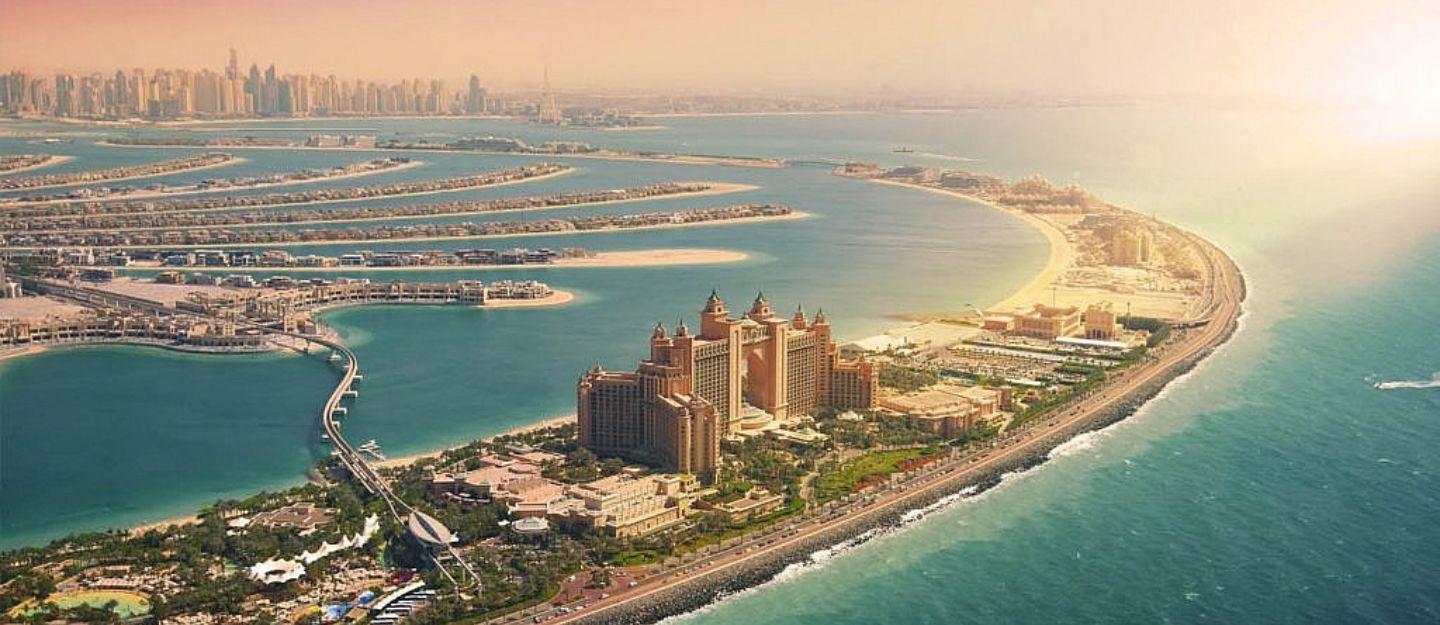
The extraordinary way Palm Jumeirah was built highlights the scale of the engineering effort. The island required approximately 94 million cubic metres of sand and seven million tonnes of rock. Many different techniques of the Dubai artificial islands construction process were used to build Palm Jumeirah
Dredging and Sand Placement for Expansion of Dubai Coastline
Trailing suction hopper dredgers collected sand from deep-sea beds and sprayed it into position using a technique called rainbowing.
GPS Precision Shaping
Real-time differential GPS allowed engineers to shape the palm fronds and crescent breakwater with accuracy up to 10 millimetres.
Breakwater Construction
An 11-km crescent-shaped breakwater was built using layers of sand, geotextile fibre and rock boulders, forming a barrier against wave action.
Ground Compaction
Vibro-compaction and dynamic compaction techniques were used to stabilise the reclaimed ground and reduce liquefaction risks.
These methods form the basis of how Dubai’s artificial islands were made across other similar megaprojects. Moreover, an interesting fact about Palm Jumeirah is that its entire engineering and construction was documented and featured in National Geographic’s ‘Megastructures’ and Discovery’s ‘Extreme Engineering’ documentaries.
FAQs
How long did it take to build the Palm Jumeirah?
Construction of Palm Jumeirah off the coast of Dubai took about six years, from 2001 to 2007.
Are the World Islands made using the same method as Palm Jumeirah?
For those wondering how the World Islands were created, it is important to know that the construction of the project used similar techniques. These include dredging and land reclamation.
What environmental considerations were involved in building Dubai’s islands?
Measures included marine habitat protection, shoreline erosion control and water circulation management.
When will Palm Jebel Ali be completed?
There is no official announcement regarding the Palm Jebel Ali completion date.
The construction of Dubai’s artificial islands was achieved through a combination of large-scale dredging, marine engineering, breakwater protection and advanced compaction systems. Technology-driven Dubai megaproject construction methods and proven land reclamation techniques has played a major role in the success of these projects.
The strategic expansion of Dubai into the sea is also contributing to Dubai’s expanding real estate scope and its attractiveness. Many new projects in Dubai are envisioned to rise among these coastal settings, capitalising on the pristine waterfront environment.
The already established projects and neighbourhoods also continue to benefit from the emergence and presence of unique seafront developments. There is an ample amount of luxury properties for sale in Palm Jumeirah that offer both refined living and a potentially lucrative scope.
For more information on new real estate development techniques and trends, stay connected to the UAE’s leading real estate blog.