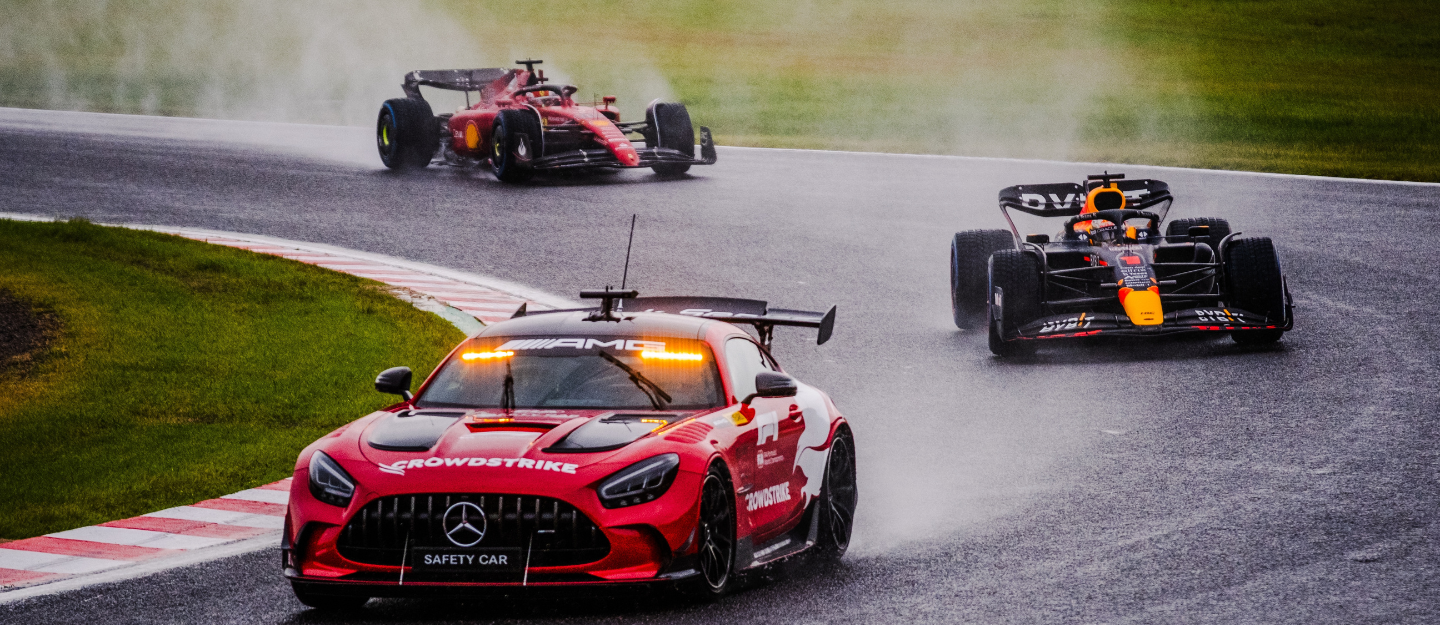
The safety car is one of the most crucial elements in Formula 1. Its deployment during a race not only slows down the cars on track but can also significantly impact team strategies, reshuffling positions. It also creates dramatic moments that significantly affect the outcome of the Grand Prix.
What Is the Safety Car in Formula 1?
The Formula 1 safety car is a high-performance vehicle driven by a professional driver appointed by the Fédération Internationale de l’Automobile (FIA). Its job is to control the pace of the cars on track when an incident, debris, or dangerous weather conditions make high-speed racing unsafe. Apart from this physical vehicle, there is also a virtual safety car, which is brought in to manage smaller on-track issues.
During a Safety Car period, the field bunches up behind it in the order they were running. Overtaking is prohibited and F1 pit stops become strategic opportunities. Drivers are responsible for maintaining tyre temperature and avoiding collisions while following closely at reduced speeds. Moreover, the current safety cars are top-tier machines: Mercedes-AMG series, which is one of the production cars that feature F1 technology and Aston Martin Vantage, specially modified to handle extreme conditions.
Who Drives the Safety Car?
The FIA appoints professional drivers with extensive racing experience. One of the most recognised names in this category is Bernd Mayländer, who has been an F1 Safety Car driver for over two decades. In addition, the role of the Safety Car driver is demanding. For instance, he must drive fast enough to keep F1 cars’ tyres and brakes warm, but also slow enough for safety.
Evolution of the Safety Car in Formula 1
The Safety Car was first introduced in Formula 1 in 1973, but it became a regular part of races in the 1990s and 2000s. Since then, this category of safety cars in F1 has seen major improvements, such as better GPS and telemetry systems, the incorporation of high-performance vehicles to keep up with modern F1 cars and stricter safety rules shaped by past incidents. The introduction of the Virtual Safety Car (VSC) is also one of the F1 safety innovations that made it easier to tackle track issues. Overall, the Safety Car has grown from a basic pace-control vehicle into a key part of F1’s advanced safety system.
F1 Safety Car Deployment Reasons
The FIA deploys the Safety Car in situations where hazards are too severe for drivers to navigate at racing speeds. Some common reasons include:

1. On-track accidents
If a car crashes and marshals need to clear debris or recover the vehicle, slowing the field is essential. Heavy crashes, especially in high-speed corners, can leave carbon fibre, fluids and components scattered across the track.
2. Hazardous weather
In torrential rain or extremely low visibility, cars aquaplane easily, making normal racing too dangerous. The Formula 1 Safety Car helps regulate speeds and keeps the race going until conditions improve.
3. Marshall activity
Marshals are the unsung heroes of Formula 1. When they step onto the track to handle incidents, the Safety Car ensures they can operate safely without cars flying past at 300 km/h.
4. Track blockages
If a car stops near the racing line or dangerous objects, such as the debris of a broken front wing, obstruct the track, the FIA may call out the Safety Car rather than red-flag the session. In every case, the Safety Car prioritises safety without interrupting the race unless necessary.
How the Safety Car Affects Race Strategy
For teams and strategists, a Formula 1 Safety Car period can be both a blessing and a curse.It brings all the cars close together again, wiping out big leads and giving mid-pack drivers a chance to fight for better positions.
Here’s how it impacts race dynamics:
1. Pit stop advantages
When the Safety Car is on track, the field is slower, meaning drivers who pit lose significantly less time. This makes it a prime opportunity for teams to stop for fresh tyres or adjust strategy. Sometimes, a well-timed Safety Car can even hand a struggling driver an unexpected advantage.
2. Strategy reshuffling
Teams constantly update strategies during a Safety Car period. A race expected to be one-stop might suddenly switch to two stops or vice versa. Engineers use this time to analyse data, tyre wear and new opportunities.
3. Field bunching
A ten-second lead can disappear instantly. This creates excitement for spectators but frustration for drivers who had built a comfortable gap through hard work.
4. Tyre temperature challenges
Following a Safety Car means driving slowly, which causes tyres and brakes to cool down. This can lead to tricky restarts, lockups or loss of grip as soon as racing resumes.
5. Dramatic restarts
Once the Safety Car goes in, the leader controls the pace until the green flag is shown. A good restart can help drivers secure a lead, but a poor one may open the door for overtakes from behind. Moreover, no two Safety Car periods have the same outcome and that unpredictability keeps teams and fans on their toes.
F1 Safety Car Procedure
The deployment of the Formula 1 Safety Car follows a strict protocol:
- An incident happens and the FIA checks the situation.
- Yellow flags and Safety Car boards appear and drivers slow down.
- The Safety Car comes out of the pit lane and drivers line up behind it.
- Cars that are one lap behind may be allowed to catch up and rejoin the same lap.
- The Safety Car turns off its lights to signal the end of the period.
- The race leader controls the pace until they cross the restart line.
FAQs
How do drivers and teams know when the Safety Car is coming out?
Drivers and teams are alerted through radio messages, official FIA signals and the appearance of yellow flags and Safety Car boards around the track.
What are the rules about overtaking during a Safety Car period?
Overtaking is not allowed during a Safety Car period unless a driver is specifically instructed by the FIA.
What changes to the Safety Car rules were introduced after the 2021 Abu Dhabi Grand Prix?
After the 2021 Abu Dhabi GP, the FIA changed the Safety Car rule so that all lapped cars must unlap themselves before a restart.
That is all about the Formula 1 Safety Car. It is a crucial safety element in this thrilling sport and ensures that drivers, marshals and fans can enjoy the excitement of racing without compromising safety.
If you are an F1 fan, the Abu Dhabi GP 2025 is all set to get in full swing in the coming month. Besides, if you are looking for a ride that ticks all the boxes of speed and exhilaration, check out these new cars for sale in the UAE, offering a plethora of choices.
To learn more about F1 racing, keep reading dubizzle’s autos blogs.
Cover image credits: Shutterstock Image Contributor – Jay Hirano
Related Posts