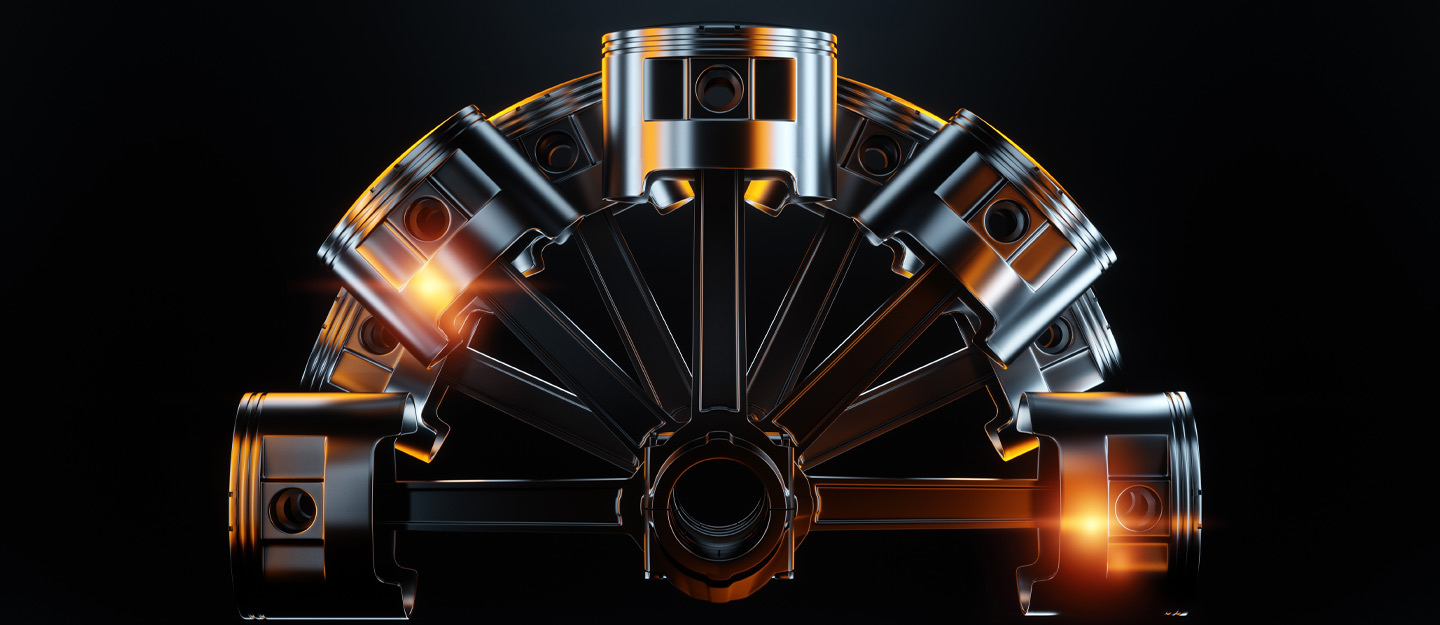
The piston is an essential component of a combustion engine. It also converts the energy released during combustion into mechanical motion. The combustion process is heavily dependent on the back-and-forth motion of the piston. This allows the air-fuel mixture to be compressed. This motion plays a pivotal role in the overall performance of a vehicle.
Here are all the details about the piston, its function, types, components and more.
Function
A piston is an essential part of the combustion chamber that converts the heat energy released during combustion into mechanical energy needed to move a vehicle. It transfers the force from the expanding gases within the cylinder to the crankshaft with the help of a connecting rod and piston rings. It is also responsible for compressing the air-fuel mixture in the combustion chamber to produce the charge required for ignition. The charge created and the force produced is required to power a vehicle.
The design, shape, weight and material of the piston also impact the power output, fuel consumption and efficiency of the engine. For instance, a lightweight piston will allow the engine to reach high revs by reducing inertia. Whereas, a well-sealed piston will generate more power by improving the compression of the air-fuel mixture in the chamber.
Types of Pistons
There are three types of pistons
- Flat standard: These provide a uniform compression ratio.
- Semi-spherical: These pistons have a concave or semi-spherical top. It lowers the compression ratio and prevents engine knock.
- Multi-spherical: These pistons have a raised top, increasing the compression ratio and generating more power.
Components
A detailed description of all piston parts is as follows
Piston Head
The piston head, also known as the piston crown, refers to the top surface of the piston. It withstands extreme temperatures and pressure due to the running engine. It is made from special alloys designed to aid in combustion with higher capabilities to resist heat and pressure. The piston head is made with channels and cavities and allows uniform combustion in the cylinder by creating a swirl in the air-fuel mixture.
Piston Pin
A piston pin, also known as a wrist pin, is a solid or hollow shaft that goes through the skirt. This car engine component serves as a pivot for the connecting rod and is located in the piston ring bushing. This enables the back-and-forth movement of the piston when the vehicle engine is running.
Since the piston pin requires strength to perform its function, it is made from alloy steel and is made to fit the piston bearing. Furthermore, a hole in the connecting rod lubricates it with oil to reduce friction due to pivotal movement.

A piston pin can be categorised into three different configurations depending on the engine type and mounting style. The stationary piston pin is mounted to the piston bosses and is not free to move at either end. On the other hand, the semi-floating pin is clamped to the connecting rod on one end. Lastly, the fully-floating pin is free to move at both ends and is only secured by plugs or clips attached to the piston bosses.
Skirt
The piston skirt is the cylindrical wall of a piston. It is made from cast iron or steel to withstand high-temperature conditions and has exceptional wear resistance. It is also self-lubricating due to its slightly rough surface.
The grooves present on the skirt enable the piston oil ring and compression ring to be mounted on the skirt. It is responsible for aligning the piston assembly in the cylinder. It also acts as a piston guide as the movements of the piston are irregular and can hit the cylinder walls in the absence of a skirt.
There are different styles of the skirt made for specific applications in different vehicles. The cylindrical shaped full skirt is used for heavy-duty vehicles whereas the slipper skirt is downsized to decrease the weight of the component.
Piston Rings
The Piston rings are the most crucial components of a piston as most piston issues arise due to defective rings. They are circular pieces of split rings that are mounted into the piston groves located on the skirt. The number of piston rings can vary in a car engine; however, most engines have three rings. The gap between two rings is called piston ring lands.
The split ring design of these rings facilitates flexibility which enables a spring action, allowing the rings to retain their position. It also makes installing the rings easier. It is made from cast iron or steel to ensure efficient working even under extreme conditions.
The main function of the piston rings is to seal the combustion chamber to ensure that the air-fuel mixture does not escape. It is also responsible for regulating engine oil usage and transferring heat from the piston to the cylinder walls. Typically, there are three types of piston rings present in an engine.
- Compression/pressure ring
This is the topmost ring located near the combustion chamber. This seals off the combustion chamber and prevents the hot expanding gases from leaking. It also transfers heat from the piston to the cylinder walls.
- Wiper/Scraper ring
This split ring is located between the compression ring and the oil control ring. This ring serves as a wiper and scrapes the oils off the cylinder walls. It also acts as a sealant for the combustion chamber.
- Oil control ring
This piston ring removes excess oil from the cylinder walls via the small holes present on its surface. It is the lowermost ring on the piston and consists of two thin surfaces. The small holes allow the excess oil to flow back into the crankcase.
Connecting Rod
A connecting rod or piston rod is one of the most essential parts of the piston as it connects the piston to the crankshaft. It allows the up-and-down movement of the piston in the combustion chamber. The connecting rod has to go through a lot of mechanical strain due to constant movement, therefore it needs to be sturdy enough. This is why the rod is typically made out of steel, aluminium or iron depending on the size and performance requirements of a vehicle.
The connecting rod aids in the rotational motion of the crankshaft, which delivers the power required to move a vehicle. It has various designs such as parallel and tapered rods, cracked joints, straight and angled separation rods and milled joint designs.
Connecting rods can be divided into three parts
- Small end
The smaller end of the rod consists of a rod eye and piston bushing. It connects the rod to the piston with the help of a piston pin.
- Big end
The big end of the rod connects to the crankshaft. It has a split design making it easier to install.
- Connecting rod beam
The rod that connects the small end to the big end is known as the connecting rod beam. It typically has a double T design and may have a hole to transfer engine oil to the cylinder. Then engine oil works as a lubricant for all components.
Connecting Rod Bolt
The bolts connect the rod to the crankshaft. The connecting rod bolts are typically made from steel; however, aluminium bolts can also be used in engines where a reduction in weight is needed. Connecting rod bolts made of nickel are mostly used in heavy-duty engines for more strength.
The bolts help the connecting rod to bear the mechanical strain caused by crankshaft movements and therefore are designed to be a little flexible. It ensures smooth engine operation by guiding each piston stroke.
Piston bearing
Piston bearings, also known as piston bushing, are metal shells located at either end of the connecting rod. It is made from silicone aluminium, silicone copper, lead copper, and others. The piston bearing enables the rod transfer motion to the crankshaft. There are two types of piston bearings, the big end bearings and the small end bearings.
Signs of Piston Damage
Some signs and symptoms of piston damage are:
- Increased oil consumption
- Reduced engine performance
- Poor acceleration
- Engine noise due to the piston knocking against the cylinder
- Engine oil leak
- Dark car exhaust smoke
- Engine overheating
- Check engine light is on
- Rough engine idling or stalling
FAQs
What does piston mean in automotive?
A piston is the moving component in the engine that is contained by a cylinder. It is responsible for transferring force from expanding gases in the combustion chamber to the crankshaft.
What is a piston made of?
Pistons are typically made from cast or forged, high-temperature-resistant aluminium silicon alloys.
How many pistons are in a car?
Most cars have between four to twelve pistons in the engine’s cylinder. However, some rare cars with a W16 engine have 16 pistons.
This is all about the piston and its critical role in a vehicle’s engine. Even a small issue with this component of the car engine can significantly impact the vehicle’s performance. This is especially crucial when considering buying a new car for sale in the UAE.
Stay connected to UAE’s leading auto blog to learn more about car parts and their functions.
Related Posts