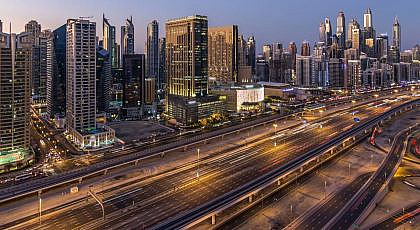
The UAE boasts a well-connected system of roads and highways, providing motorists with convenient options for hassle-free road trips and commutes. Connecting large metropolitan areas as well as small villages in different emirates, all the major UAE highways are mapped in a well-thought-out way, some even stretching hundreds of kilometres
List of Major UAE Highways and Their Routes
The routes that make travelling across the country easy and convenient include the following major highways in the UAE.

E11
Stretching 558 km, E11 is the UAE’s longest highway. It is known by alternate names that change from emirate to emirate, such as Sheikh Maktoum Bin Rashid Road, Sheikh Zayed Road and Sheikh Mohammed Bin Salem Road. The strategic route of E11 highway links all the major UAE emirates except Fujairah.
E311 or Sheikh Mohammed bin Zayed Road
Connecting different emirates, E311 is a strategically planned 140 km long road. Also known as the Sheikh Mohammed bin Zayed Road, the highway begins in Abu Dhabi at Al Shamkha. It runs through various suburbs of Dubai and offers seamless connectivity to the city centre. The road further enters Sharjah after Mirdif. The route further connects Ajman, Umm Al Quwain and links with the E11 road in Ras Al Khaimah.

E95 or Sheikh Khalifa bin Zayed Road
Running along the UAE and Oman border, the E95 highway presents a noteworthy route, which connects the villages on the eastern side of the Emirates to major cities. The highway connects with E40 on one side and E90 on the other side, towards the UAE-Saudi Arabia border.
E84 or Sheikh Khalifa Highway
This thoroughfare is more commonly referred to as Dubai-Fujairah Road, allowing motorists to travel to either emirate in around 40 to 60 minutes. It is the shortest route to travel from Dubai to Fujairah or back. Operational since 2011, it is about 30 km shorter than other routes connecting the two emirates.
E77
This E77 highway route starts at an interchange on E11 and runs all the way to Hatta. The road intersects with the Dubai-Al-Ain Highway and at Al Lehbab, it merges with E44, which further leads to Hatta. Surrounded by scenic natural features of the region, it is one of the best roads to drive in the UAE.
E44 or Al Khail Road
The E44 route is one of the UAE’s key highways, known by various names such as Al Khail Road, Dubai-Hatta Highway, Al Aweer Road and Ras Al Khor Road. The alternate names vary from emirate to emirate.

E611 or Emirates Road
Stretching 110 km, E611 is based on a route that runs through Dubai and the suburbs of various other emirates. Popularly known as the Emirates Road, this highway can also be used as an alternative route to other major highways in the UAE, including E11 and E311.
E10
The E10 highway in the UAE serves as a key route connecting Abu Dhabi to Dubai. It runs parallel to the E11. The route is strategically planned to offer a smooth passage for commuters and features important landmarks along the way. Notably, the highway passes by the iconic Sheikh Zayed Bridge, a striking architectural symbol of Abu Dhabi.
E66 or Dubai-Al Ain Road
The E66 route is more commonly referred to as the Dubai-Al Ain road. The route starts at Wafi Mall junction in Dubai and ends close to the Al Hili area in Al Ain. The road serves as a famous highway in the UAE, offering easy accessibility to the Dubai public transport network within the city and inter-emirate commutes.
FAQs
Which highway connects Dubai to Abu Dhabi?
The E11 highway (Sheikh Zayed Road) is the main route connecting Dubai to Abu Dhabi. It is one of the noteworthy arteries among the list of highways in the UAE.
What is the difference between E311 and E611 highways?
The E311 (Sheikh Mohammed Bin Zayed Road) runs through urban areas, while the E611 (Emirates Road) serves as a bypass around city traffic.
Which UAE highways connect to Oman?
The E44 Dubai–Hatta Road and E16 (Al Madam–Masafi Road) are among the UAE highways that connect to Oman.
There are some main roads and highways in the UAE, which offer transportation convenience to commuters and motorists across the country. Note that the traffic flow on each route is strictly regulated and monitored. For legal compliance and safety, make sure to follow all the UAE speed limits when using the aforementioned main roads and highways in Dubai and other emirates to ensure safety and avoid penalties.
The presence of a well-established road infrastructure makes commuting and exploring more convenient. It also makes owning a car a compelling option alongside using public transport and taxis. Buyers can choose from a wide range of new and used cars for sale in the UAE.
For more updates on commuting and travelling around, stay tuned to the UAE’s top auto blog.
Related Posts