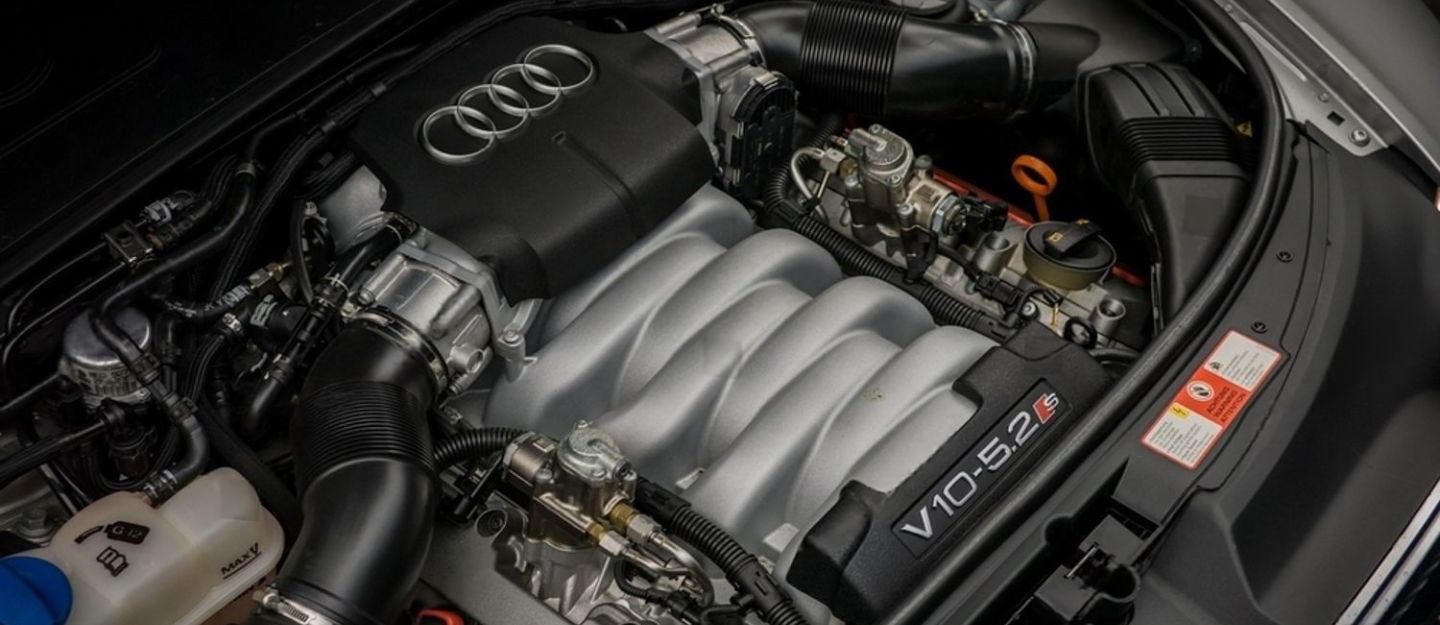
Engine configurations have long shaped the performance, character and capabilities of vehicles across different segments. Among them, the V10 engine holds a distinctive place due to its rare combination of power, smoothness and mechanical complexity. Positioned between the widely used V8 and the more extravagant V12, the V10 offers a unique engineering solution. Understanding how the V10 engines emerged explains why they became a preferred choice for performance and innovation.
History of the V10 Engine
One of the earliest mass-produced V10 engines appeared in the Dodge Viper in 1992. Developed in collaboration with Lamborghini, Chrysler engineered this 8.0-litre V10 to deliver immense torque and raw performance. Around the same time, Ford introduced a V10 for its heavy-duty trucks and vans.
In Europe, BMW, Audi and Lamborghini adopted V10s in their high-end sports cars during the 2000s. The engine also gained attention in Formula One during the 1990s and early 2000s, with nearly all teams using V10 engines before the switch to V8s and later V6 hybrids. Since then, V10 engines have powered luxury and exotic cars.
Design of V10 Engine
The V10 engine is built with 10 cylinders configured in two banks of five cylinders, forming a V shape. The ‘V’ angle commonly ranges between 60 to 90 degrees. A 90-degree V angle is more popular in road cars because it allows for easier integration into existing platforms that also support V8 Engines.
V10 engines typically have a displacement ranging from 4.8 litres to over 8.4 litres, depending on application. Most V10 engines are naturally aspirated, although some use turbocharging to increase output.
Key design elements include:

Crankshaft
Most V10 engines use a forged steel crankshaft. The crankshaft design varies, but it often uses a split-pin arrangement to optimise firing order and balance.
Firing Order
Firing order is critical in a V10 engine to ensure smooth power delivery. Engineers carefully design the order to reduce vibrations.
Balance and Smoothness
V10s are inherently unbalanced, especially compared to inline-6 or V12 engines. Manufacturers often use balance shafts or advanced engine mounts to reduce vibrations.
Cylinder Heads and Valvetrain
Most V10 engines use dual overhead camshafts (DOHC) per bank, with 4 valves per cylinder, totalling 40 valves.
V10 Engine Working
The V10 engine operates similarly to any internal combustion engine. Air and fuel enter the combustion chamber, mix and ignite via spark plugs. The explosion pushes the piston down, causing the crankshaft to turn. Each cylinder goes through four strokes: intake, compression, power and exhaust.
Air enters the engine through the air intake manifold and is controlled by throttle bodies. Some high-performance versions use individual throttle bodies for each cylinder to improve response. Fuel is delivered either directly into the cylinder or into the intake port, depending on the injection system. The spark plugs then ignite the air-fuel mixture, causing the piston to move downward during the power stroke.
The burned gases are expelled through the exhaust valves, passing through manifolds, catalytic converters and mufflers. To enhance performance, many V10 engines also incorporate advanced technologies such as variable valve timing, dry-sump lubrication and lightweight components.
Iconic Cars with V10 Engines
The V10 engines have powered some of the most remarkable vehicles across different segments, from high-performance sports cars to capable utility vehicles.
- Lamborghini Gallardo: 5.0-litre V10
- Audi R8 V10: 5.2-litre V10
- Dodge Viper: 8.0 to 8.4-litre V10
- Lexus LFA: 4.8-litre V10
- BMW M5 (E60): 5.0-litre V10
- Porsche Carrera GT: 5.7-litre V10
- Ford Triton V10: 6.8-litre V10
- Lamborghini Huracan: 5.2-litre V10
- Volkswagen Touareg V10 TDI: 5.0-litre twin-turbo diesel V10
- Volkswagen Phaeton V10 TDI: 5.0-litre twin-turbo diesel V10
Future of V10 Engines
The future of V10 engines remains open and full of possibilities. As emissions regulations tighten and electrification expands, the demand for high-cylinder-count engines is declining. Most manufacturers are shifting towards hybrid or fully electric drivetrains.
However, the V10 is not entirely extinct. Some limited-production supercars continue to use V10 engines for their performance and appeal. For example, the Lamborghini Huracan EVO and Audi R8 still feature naturally aspirated V10 engines.
FAQs
Are V10 engines naturally aspirated or turbocharged?
Most V10 engines are naturally aspirated, although a few models, especially diesel versions, use turbocharging.
What are the advantages of a V10 engine specs?
V10 engines offer strong torque, smooth power delivery, high-revving capability and a distinctive exhaust note.
Do V10 engines require special maintenance?
They require regular maintenance like any engine, but due to their complexity and high-performance nature, servicing can be more expensive.
What is the RPM redline of a typical V10 engine supercars?
It varies, but high-performance engines can rev up to 8,000–9,000 rpm, like the Lexus LFA or BMW M5 (E60).
V10 engines represent a unique combination of mechanical complexity and high-performance output. They are admired for their smooth power delivery, distinctive sound and presence in some of the most iconic vehicles ever built. As the automotive industry shifts toward electrification, the legacy of the V10 continues to reflect exceptional engineering and design.
If you are interested in leveraging the power and thrill of this engine, browse through these used cars for sale in the UAE and discover models equipped with V10 engines. You can also browse through some of the renowned cars with V10 engines, which are mentioned below:
Stay tuned to the UAE’s most popular autos blog for more information on car engines.
Related Posts